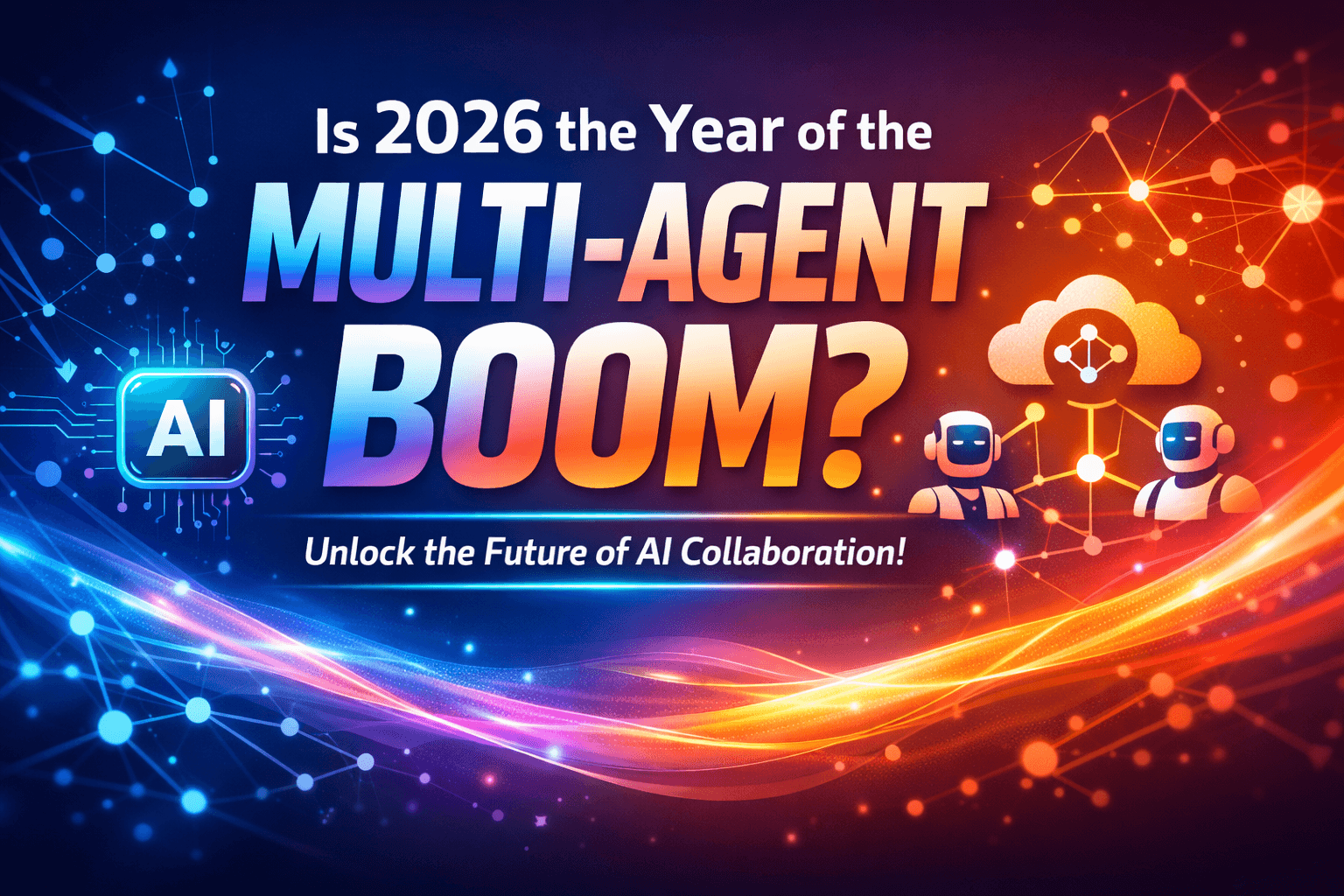
MCP Adoption Trends for 2026: Are We Entering the Multi-Agent Boom?
MCP Adoption Trends for 2026: Are We Entering the Multi-Agent Boom? Single AI agents are already reshaping workflows—but they still feel oddly… solitary. You...
Single AI agents are already reshaping workflows, but they still feel oddly solitary. You can ask a model to draft a proposal, summarize a report, or debug a function. However, the real world rarely involves a single expert working in isolation. High-value work is inherently collaborative: product teams talk to engineering, finance aligns with operations, and legal double-checks everything. Until now, our AI tools haven’t mirrored that reality. They’ve been powerful, yet fundamentally siloed.
This is why the emerging Model Context Protocol (MCP) trend is significant. As we approach 2026, MCP is quietly positioning itself as the "plumbing layer" that allows multiple specialized agents to securely share tools, data, and context, without every team having to rebuild fragile integrations from scratch. Early adopters are already experimenting with networks of agents that negotiate tasks, call shared services, and coordinate across systems in ways that resemble a digital organization rather than a simple chatbot.
In this article, we'll explore the adoption signals suggesting MCP is on track to become a standard for multi-agent collaboration, how leading teams are using it today, and what a "multi-agent boom" could mean for your architecture, workflows, and competitive edge. If you’ve been waiting for multi-agent systems to move from research demos to operational reality, 2026 may be the inflection point you can’t afford to ignore.
1) Why MCP is suddenly showing up in 2026 predictions
By late 2025, MCP shifted from a "nice to have" connector standard to the default expectation for how AI systems integrate into enterprise stacks. As organizations formalize AI roadmaps for 2026, MCP is increasingly seen as the interoperability layer that enables different models, agents, and tools to communicate effectively.
The clearest signal comes from the Solutions Review 2026 predictions, highlighting a surge in MCP adoption, cross-agent communication, and practical multi-agent systems. Early RFPs are already including language that demands interoperability and MCP compliance, reinforcing what industry experts describe as a shift to platform-level thinking.
This matters because 2025 validated single-agent productivity. In 2026, value will come from coordinated systems that can delegate, verify, and compose capabilities across tools and teams. If MCP becomes the plumbing, the next challenge is not connectivity, but coordination.
2) The 2026 multi-agent stack: from connectors to coordination
In 2026, think of the stack as MCP at the bottom, serving as transport and tool interface, with new coordination layers above it. MCP standardizes how agents call tools and pass data, but it does not decide which agent to trust, what it is allowed to see, or how shared actions are represented.
These gaps are where discovery, trust, permissions, and shared action schemas appear as distinct layers. On top of MCP, organizations are starting to define catalogs of approved agents, policy engines that gate access, and common schemas for tasks like "submit expense," "update care plan," or "open incident."
This enables composable ecosystems of reusable micro-agents. Each micro-agent does one job well, such as summarizing a policy, validating a claim against source documents, or filing a ticket into ITSM, then exposes that capability through MCP-compatible tools and structured outputs.
Verticalization accelerates this pattern. Healthcare, finance, and public safety agents must call regulated systems and exchange sensitive context safely, making a standard interface essential, as reiterated in the Solutions Review analysis. The near-term architecture is an orchestrator agent plus a roster of specialists. Once that roster grows, the first challenge is simply finding the right agent at the right time.
3) What breaks first in 2026 (Part 1): Agent discovery and marketplaces
MCP solves how agents call tools, not which agent should be called for a given task. As enterprises scale from a handful of pilots to hundreds of micro-agents, the first visible crack in 2026 will be discovery. This is already hinted at in early platform roadmaps and RFP language highlighted in the Solutions Review 2026 predictions.
Most organizations will set up internal catalogs or plug into emerging marketplaces. Yet without shared metadata standards, discovery will be noisy and fragile. Teams will struggle to answer simple questions like: “find an agent that can reconcile invoices,” “find an agent approved for SOX workflows,” or “find an agent that can call SAP tool X via MCP.” Each query needs consistent descriptors for capabilities, costs, latency, compliance posture, and supported schemas, which current MCP usage does not enforce, as industry experts also note in the Solutions Review analysis.
Failure modes are predictable: duplicated agents that do the same thing, inconsistent naming, shallow one-line descriptions, and “prompt only” agents that lack machine-readable contracts, so they cannot be safely composed. A real discovery layer will require capability taxonomies, versioning, dependency graphs, evaluation scores, and strict input or output schemas. Even then, finding an agent is not enough because the next question is whether you can trust it.
4) What breaks first in 2026 (Part 2): Trust, reputation, and verification between agents
As soon as enterprises wire dozens of MCP-compatible agents together, risk compounds. One poorly aligned or compromised agent can contaminate an entire chain of actions, from misclassifying a document to triggering a financial transaction. This is why multi-agent systems are already flagged as a control challenge in the Solutions Review 2026 predictions.
By 2026, reputation systems will shift from "nice to have" to mandatory, particularly in cross-vendor ecosystems and agent marketplaces. Every agent will need basic trust primitives: provenance (who built and operates it, under what SDLC), attestations (what data and scenarios it was evaluated on), audit logs (what it actually did in production), and runtime monitoring (what it is doing right now, with which tools and data).
Verification patterns will spread in parallel. Independent checker agents will re-validate high-impact outputs, consensus flows will require agreement from multiple diverse agents, and policy agents will gate tool calls or data access based on corporate rules. RFPs will increasingly ask vendors to prove both interoperability and evidence of these controls, echoing the late 2025 expectation that platforms align with formal AI governance strategies noted in Solutions Review’s analysis. Even so, trust alone is not sufficient if individual agents can still do too much without hard guardrails.
5) What breaks first in 2026 (Part 3): Inter-agent permissions and least-privilege actioning
If discovery and trust determine which agent you call, permissions determine what that agent is allowed to do once invoked. MCP cleanly exposes tools to agents, but multi-agent collaboration tangles those permissions into opaque chains: agent A delegates to agent B, which calls tool C, which touches data set D. By 2026, this indirection will collide with existing RBAC and data governance models, becoming the primary blocker for production multi-agent deployments in heavily regulated sectors, a concern already surfacing in industry forecasts.
Enterprises will need scoped credentials attached to specific actions, short-lived delegation tokens that encode who can call whom, step-up approvals for sensitive operations, and policy as code evaluated at runtime instead of static ACLs. The "blast radius" problem will dominate architecture reviews: a single over-permissioned agent, once callable by other agents, effectively becomes an enterprise-wide superuser.
A practical model will converge around capability-based permissions (grant rights to fine-grained actions, not broad roles), explicit delegation boundaries between agents, and mandatory audit trails for every cross-agent call. As analysts note in 2026 AI governance discussions, even perfect permissions cannot solve the next barrier: agents still need a shared action language to interoperate at all.
6) What breaks first in 2026 (Part 4): Standard schemas for actions and outcomes
Tool calling already works, but multi-agent workflows fracture when outputs are not reliably structured, comparable, or composable. One agent’s "ticket created" is another agent’s opaque JSON blob, so orchestration logic devolves into brittle, vendor-specific adapters. As multi-agent adoption accelerates, this incompatibility will be called out in 2026 RFPs alongside MCP compliance and governance expectations already highlighted in industry predictions.
The pressure will trigger early schema wars. Vendors will ship their own action schemas for common operations (create ticket, approve payment, update CRM, generate report), while large enterprises and consortia push for convergence to reduce integration cost and risk. This is not "just JSON output." A usable schema must carry intent (what business outcome is requested), constraints (limits, SLAs, approvals), side effects (systems and records touched), idempotency guarantees, error semantics, and rollback behavior, so downstream agents can reason about safety and recovery.
Enterprises will prioritize standardization where volume and risk are highest: ITSM workflows, CRM updates, finance operations, and compliance actions such as access requests and policy acknowledgments, mirroring the governance-centric focus in 2026 analyst commentary. Taken together, these breakpoints point to a missing protocol layer that must sit above MCP itself.
7) The next protocol layer above MCP: what it must add for 2026 multi-agent reality
MCP will be the necessary plumbing in 2026, but multi-agent reality will demand a coordination layer that standardizes how agents are discovered, trusted, authorized, and wired into shared action schemas. Analysts already flag this shift from single model tooling to ecosystem infrastructure in 2026 enterprise AI forecasts.
At minimum, this next layer must add:
- A common agent registry and metadata standard (capabilities, domains, risk level, owner, version).
- Strong identity and attestation, including who built the agent, how it was evaluated, and what policies it adheres to.
- Delegation and authorization semantics that encode who can call whom, under what conditions, and with which scoped rights.
- Shared action contracts, not just JSON formats, for high-value workflows.
- Interoperable audit logging so every cross-agent step is reconstructable across vendors.
In practice, an agent would publish its capabilities and schemas, receive an attestation, register in a searchable catalog, then be callable using short-lived delegation tokens that automatically emit standardized logs. This reframes MCP from a connector standard to a backbone and shifts competitive advantage to ecosystems, a trend multiple experts highlight in 2026 AI technology commentary. Expect fragmented approaches in early 2026, then rapid convergence under enterprise procurement pressure by year-end. Leaders in late 2025 should start defining internal schemas, risk tiers, and registry requirements so they can plug into that layer instead of being constrained by it.
8) What to do now (late 2025) to prepare for MCP-driven multi-agent adoption in 2026
By late 2025, organizations that act on MCP and multi-agent assumptions, not hype, will be positioned to benefit from the 2026 shift highlighted in industry forecasts.
For enterprise buyers, refresh 2026 RFP templates to require MCP compatibility plus explicit answers on agent discovery metadata, permissioning models, audit logging, and supported action schemas.
For platform teams, pilot a small internal agent catalog, define capability naming conventions, and build evaluation harnesses that test reliability, safety, and schema adherence across agents.
For vendors, publish machine-readable capability manifests, commit to stable action schemas for common workflows, and document controls and monitoring for cross-agent usage, aligning with expectations in 2026 AI technology commentary.
For security and governance, codify delegation policies, least privilege standards, and incident response playbooks tailored to agent-to-agent workflows.
The objective is not more agents, but predictable, governable composition.
Conclusion
Heading into 2026, the clearest signal isn’t just that MCP adoption will grow, but that MCP is on track to become the default substrate for how agents find each other, share capabilities, and coordinate work. As multi-agent systems move from polished demos to production-grade programs, the pressure points are already visible: how agents discover one another, establish trust and reputation, enforce permissions across boundaries, and describe actions in a way that every participant can understand.
These four breakpoints—discovery, trust, permissions, and standardized action schemas—will separate experiments from durable platforms. The organizations that succeed won’t be the ones with the flashiest agent UIs or the largest model budgets; they’ll be the ones that treat MCP as the foundation of their AI stack and deliberately build the coordination layer above it, rather than improvising integrations one project at a time.
If you’re planning AI initiatives for 2026, now is the moment to get specific:
-
Audit your current agent and tool landscape
- Map where agents already exist (or are planned), what tools they use, and how they currently communicate, if at all.
- Identify ad hoc integrations, duplicated connectors, and bespoke APIs that MCP could unify.
-
Stress-test against the four breakpoints
- Discovery: Can new agents easily find and understand existing capabilities, or does every integration start from zero?
- Trust & reputation: How do you decide which agents and tools are reliable, and how is that surfaced to others?
- Permissions: Are access controls centralized and auditable, or scattered across services and scripts?
- Action schemas: Do your agents share a common “language” for actions, or is every workflow custom-wired?
-
Define a roadmap before you scale
- Prioritize MCP-aligned standards for how agents register, authenticate, request access, and describe actions.
- Start with one or two high-value, multi-agent workflows and design them as if MCP is the starting point, not an afterthought.
- Establish governance: who owns the coordination layer, how changes are made, and how new agents join the ecosystem.
-
Invest in the coordination layer, not just the agents
- Treat orchestration, policy, and shared schemas as core infrastructure, on par with your data platform or API gateway.
- Look for platforms, libraries, and internal patterns that make it easy to plug new agents into an MCP-based environment.
The multi-agent boom won’t arrive as a single breakthrough. It will emerge from organizations that quietly standardize how their agents talk to each other and to the rest of the stack. MCP is the strongest candidate yet for that standard, but it will only deliver its full value if you design for it intentionally.
If you’re serious about scaling AI in 2026, don’t wait for the ecosystem to "settle." Audit your agents and tools against the four breakpoints today, then set a clear roadmap for discovery, trust, permissions, and action schemas. The teams that move first to build a robust MCP-based coordination layer will be the ones defining what "multi-agent" actually means in practice—and capturing the outsized value that comes with it.
Explore More Topics
Discover more articles about AI, automation, and workflows
Related Articles
Continue exploring more insights on model context protocol