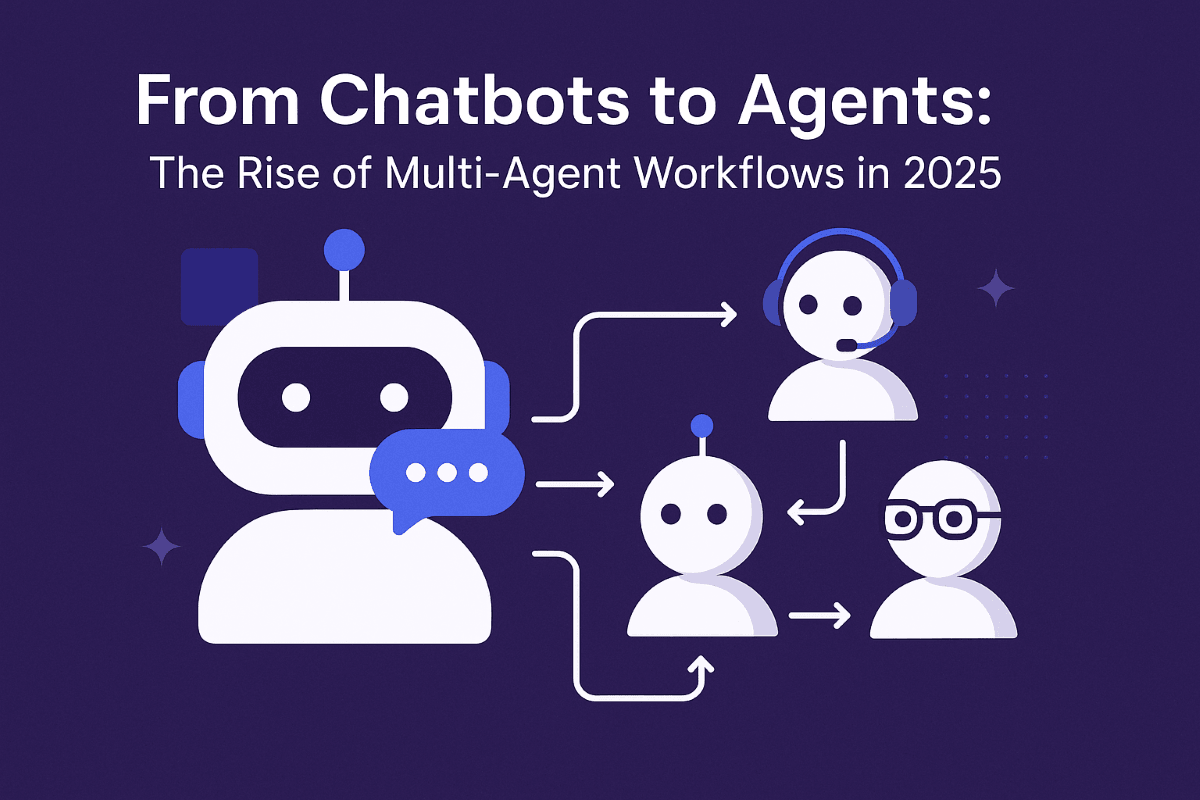
From Chatbots to Agents: The Rise of Multi-Agent Workflows in 2025
Discover how chatbots are evolving into multi-agent workflows in 2025.
In the early days of conversational AI, chatbots were the stars: single entities designed to respond to user queries, answer FAQs, or guide simple flows. But as business demands grew more complex, that model began to strain under multi-step workflows, interdependent tasks, and cross-system orchestration. Fast-forward to 2025, and we’re in the era of multi-agent workflows — teams of specialized AI agents coordinating to solve broader problems. This transition—from chatbots to agents—is reshaping how organizations architect intelligent systems and deliver automation at scale. IBM Research’s overview of multi-agent AI captures the same shift from conversational helpers to orchestration-minded teammates. For practical implementation ideas, compare the patterns here with Harnessing Agentic AI for Business.
In this article, we’ll explore what multi-agent workflows are, why they’re gaining traction in 2025, the key enabling technologies, real-world use cases, challenges to watch, and how platforms like AffinityBots can help enterprises adopt this next wave of AI automation.
What Is a Multi-Agent Workflow?
From Single Bot to Agent Teams
A chatbot is essentially one “actor” that listens, reasons, and replies. In contrast, a multi-agent workflow comprises multiple specialized agents, each with defined roles and capabilities, collaborating to achieve a larger, often multi-step goal. As defined in recent AI literature, these systems decompose a high-level user request into subtasks, assign them among agents, and coordinate their interaction.
Instead of a monolithic virtual assistant, think of an AI “crew” (or “squad”) where one agent handles retrieval, another validates data, another coordinates action, and so forth. The workflow itself becomes an orchestration layer—the same distinction we unpack in Agents vs. Workflows.
Key Terminology
- Agentic Flow / Agentic WorkflowA structured sequence of steps executed by multiple agents toward a common goal. This often involves planning, delegation, tool use, and iterative decision-making.
- **MCP (Model Context Protocol)**A protocol that lets agents interface reliably with tools, APIs, and data sources in a standardized way. We break down why it matters in MCP 101.
- **A2A (Agent-to-Agent protocols)**Communication, negotiation, and collaboration mechanisms that let agents coordinate, share tasks, and hand off responsibilities among themselves.
Why 2025 Is the Year of Multi-Agent Workflows
- Complexity Outpaces Single-Agent Models
Many business tasks require branching logic, conditional checks, cross-system coordination, and error handling. A single agent quickly becomes brittle in these scenarios. Multi-agent architectures shine by distributing complexity.
For example, customer support might require (a) classifying sentiment, (b) retrieving account data, (c) updating records, and (d) drafting a reply. Rather than a single chatbot doing all this, separate agents can specialize and operate in parallel or in a pipeline.
- Frameworks & SDKs Have Caught Up
2025 has seen the release and maturation of tools specifically designed for multi-agent workflows:
- The OpenAI Agents SDK (released in March 2025) helps developers spin up multi-agent orchestration with tracing and guardrails. OpenAI’s Agents overview is a good starting point for experimentation.
- LangChain has grown beyond single-chain logic to support agent-to-agent communication and orchestration for business-grade workflows.
- Research projects like EvoFlow and EvoAgentX are automating the design and evolution of diverse agent workflows.
These frameworks remove much of the plumbing burden—developers no longer need to handcraft coordination logic from scratch.
- Standardization & Interoperability
With growing adoption of protocols like MCP, agents can reliably interface with external data sources and tools in a unified fashion. That standardization helps unify workflows across heterogeneous systems.
Additionally, platforms from consultancies (e.g. PwC’s Agent OS) are emerging to help enterprises deploy and interconnect agent networks.
- Business Demand & Use Cases Pushing Adoption
Enterprises are already piloting agentic systems. For instance:
- Citigroup is testing AI agents that can autonomously complete multi-step tasks using a single prompt.
- KPMG launched “Workbench”, its multi-agent AI platform.
- However, Gartner predicts that over 40% of agentic AI projects will be scrapped by 2027 due to vague value, high cost, or implementation complexity.
In other words, the promise is real—but caution and discipline are essential.
Real-World Use Cases Driving Adoption
Here are several applications where multi-agent workflows are already showing traction:
| Industry / Domain | Use Case | Description |
|---|---|---|
| Customer Support & CX | Smart complaint resolution | One agent classifies sentiment, another fetches user history, a third crafts a personalized response, while a supervisor agent validates and escalates if needed. |
| Marketing & Campaigns | Multi-channel orchestration | Agents manage campaign scheduling, content generation, ad budget allocation, and performance analysis in a feedback loop. |
| Finance & Ops | Process automation & compliance | Agents audit transactions, flag anomalies, produce reports, and trigger workflows for remediation. |
| R&D & Pharma Simulations | Experiment planning & analysis | Agent teams run simulations, aggregate results, adjust parameters, and iterate—reducing time and cost. |
These are just a few examples, but they hint at the broader shift from reactive chatbots to predictive, autonomous workflows.
Building Multi-Agent Workflows: Architecture & Design Patterns
When designing a multi-agent system, several architectural patterns and principles come into play:
Orchestration vs. Decentralization
You can choose between a central orchestrator that coordinates agents or a decentralized coordination model where agents negotiate among themselves. Research such as AgentNet explores decentralized architectures to reduce single points of failure and improve adaptability. When you’re ready to operationalize either approach, layer in the governance practices from AI-First Workflows.
Workflow Composition & Topology
Workflows may be linear pipelines, DAGs (directed acyclic graphs), or dynamic graphs that evolve at runtime. Tools like EvoFlow evolve workflow topologies via crossover and mutation.
Protocol Layers
- MCP (Model Context Protocol): Ensures agents can fetch context, call APIs, or use tools in a consistent, secure manner.
- A2A (Agent-to-Agent): Protocols for agents to request help, share results, or negotiate subtasks.
Observability, Tracing & Debugging
Running many interacting agents introduces complexity in monitoring, debugging, and tracing flows. Agents SDKs now include built-in tracing features to handle this.
Safety & Guardrails
Because agents may act autonomously, developers must embed reactive constraints, permission models, prompt-level guardrails, and fallback strategies.
Challenges & Risks in 2025
While the multi-agent paradigm is compelling, it’s not without pitfalls:
- Overhype & Agent WashingSome vendors brand ordinary bots as “agents” to ride the trend. Gartner cautions that more than 40% of such projects may be cancelled by 2027 due to unclear ROI.
- Cost & EfficiencyRunning multiple agents, each invoking LLMs, can multiply compute costs. Careful budgeting, caching, and model selection are critical.
- Coordination OverheadToo much back-and-forth between agents can create inefficiencies or circular dependencies.
- Security, Permissions & TrustWhen agents access internal systems or sensitive data, misconfigurations or prompt injection can create risks. Protocols like MCP must be securely implemented.
- Explainability & DebuggingIt becomes harder to trace which agent made a suboptimal decision, and why.
- Human Oversight & Ethical LimitsComplete autonomy is rarely acceptable for high-stakes decisions. Humans must retain audit control over critical flows.
Best Practices & A Roadmap for Adoption
To increase your chances of success in deploying multi-agent workflows, here are recommended guidelines:
- Begin with well-scoped pilotsStart small. Choose a use case with clear boundaries (e.g., document summarization and routing) before expanding.
- Define roles for agents clearlyEach agent should have a narrow, well-defined responsibility rather than overlapping scope.
- Use proven frameworks & SDKsTools like OpenAI Agents SDK or LangChain reduce boilerplate and prevent architectural missteps.
- **Leverage standardized protocols (MCP, A2A)**This ensures interoperability and easier scaling of agents across systems.
- Prioritize observability and instrumentationEnable tracing, logging, health checks, and dashboards to monitor agent performance and interactions. We share practical examples in Unlocking Productivity.
- Implement fallback and human-in-the-loop controlAlways include safe fallback paths or escalation to humans when confidence is low.
- Iterate using evolutionary or auto-design techniquesTools like EvoFlow and EvoAgentX can help refine agent workflows over time. arXiv+1
- Track ROI and adjustMeasure time saved, errors prevented, cost of compute, and business impact so you can validate the value.
The Role of AffinityBots in the Multi-Agent Revolution
At AffinityBots, our mission is to help organizations embed intelligent automation seamlessly. As workflows shift from isolated chatbots to coordinated agent systems, AffinityBots can serve as the connective tissue:
- Agent Orchestration LayerWe can host and manage multi-agent workflows, abstracting away plumbing so your teams focus on business logic—not coordination.
- Protocol Compliance & ToolingOur platform can integrate with MCP-based agent tooling and support inter-agent communication, making it easier to scale your agent fleet.
- Monitoring & GovernanceWith built-in dashboards, observability, and permission controls, AffinityBots ensures you maintain control and insight over your agent networks.
- Template Workflows & Best PracticesWe’ll offer prebuilt agentic workflow templates—e.g. for support automation, marketing orchestration, compliance pipelines—to accelerate adoption.
By situating itself at the orchestration and governance level, AffinityBots is well-positioned to let enterprises adopt multi-agent systems without reinventing the wheel.
Conclusion & Outlook
The shift from chatbots to multi-agent workflows marks a watershed in how enterprises think about AI automation. In 2025, multi-agent systems are no longer theoretical—they’re being piloted, scaled, and integrated across industries. Enabled by frameworks like the OpenAI Agents SDK, standard protocols like MCP, and evolutionary workflow tools like EvoFlow/EvoAgentX, the technology foundation is maturing rapidly.
However, success won’t be automatic. Overhyped projects, coordination overhead, cost overruns, and security risks remain real challenges. Enterprises that adopt iteratively, enforce clear responsibilities, and maintain human oversight will be best positioned to harness the power of agentic AI.
TL;DR
By 2025, the future of conversational AI is shifting from standalone chatbots to coordinated multi-agent workflows—teams of specialized AI agents that collaborate to achieve complex business goals. Enabling protocols (MCP) and orchestration frameworks are fueling this transition, while evolutionary workflow design tools help optimize performance. Enterprises must proceed cautiously with pilot projects, strong governance, and clear ROI measurement. Platforms like AffinityBots can play a pivotal role by providing orchestration, monitoring, and out-of-the-box agent templates.
Related Articles
Continue exploring more insights on chatbots